Home / About Laghum Economy / The idea
The idea
An upgrade of the economic system
Laghum Economy keeps the market as the engine and updates the rules. Nature gets a price, taxes on work come down correspondingly, and the sustainable choice becomes the one that pays off.
Produce as much as possible at the lowest possible cost, regardless of the toll on nature.
Deliver maximum consumer value using as few natural resources as possible.
In 60 seconds
The problem
Our economic system was built when nature seemed abundant. Today seven of nine planetary boundaries are exceeded.1 More
The solution
Shift tax from work to the use of nature, so the overall tax level stays the same. The full model is a Sustainable Consumption Tax (SCT) at the point of sale, but every step in that direction counts and can start small. As AI changes work, this also makes welfare less dependent on taxes on jobs.2 More
The path, a fair shift
One country or union, such as the EU, can go first. The change could then spread like a domino effect. The shift should be fair for both households and companies: tax on work comes down correspondingly, and since the SCT is paid where goods are sold, those who go first are not put at a disadvantage.2 More
Enabling technology
Digital product passports, barcodes and checkout systems can now trace a product’s footprint through the supply chain, and AI helps fill the gaps in the data. That was not possible when today’s tax systems were built.2
1 Stockholm Resilience Centre and Potsdam Institute for Climate Impact Research, Planetary Health Check 2026. 2 Stefan Krook, The Laghum Economy: A New Brief for a Healthy Planet, where the reasoning and its sources are set out in full.
How it could work
From today's rules to tomorrow's
For the state, the total amount of tax stays the same but is collected differently. That changes what pays off in the market.
The state's side · simplified
Today
Laghum Economy
Same total tax level
Other taxes are left out for simplicity.
Using nature costs more
A Sustainable Consumption Tax (SCT) is added at the point of sale. The bigger a product's environmental impact, the higher the SCT.
Work costs less
The tax on work goes down correspondingly, so net pay rises and it becomes cheaper to employ people.
The market does the rest
Sustainable choices become the profitable ones. Consumers compare prices, and companies compete to shrink their footprint, for example through repair, resale, rental and longer-lasting products.
A fair shift
The shift should be fair and not a burden for ordinary households. Laghum Economy proposes a change in how tax is collected, not how much. As the tax on work comes down correspondingly, the vast majority of households get more money in their pockets and a sustainable everyday life stays affordable. The design can also protect lower incomes, for example through a higher threshold before income tax kicks in, and the shift would be phased in gradually over around a decade.
Companies stand to gain too. The tax is paid where goods are sold, not where they are made, so imported and domestic products are treated alike and exporters are not put at a disadvantage. Lower tax on work also makes it cheaper to hire.
At the same time, the whole purpose of Laghum Economy is to upgrade the economic system so that it steers towards sustainable choices. Products and habits with a heavy footprint will cost more, and choices that are lighter on the planet will pay off. This gives innovators a new brief: deliver as much value as possible using as few virgin resources as possible. Exactly how this is best designed still needs to be investigated.
With Laghum Economy, we believe we can create more value with fewer resources, and with that an even better world than today, built on new solutions. Some of these solutions already exist, while others are yet to be discovered, driven by new incentives in the market.
A price on nature at the checkout
The SCT would be included in the price you see on the shelf. Each product would carry a digital declaration of its footprint, and the bigger the impact, the higher the SCT. Until recently this was not possible. Today it can be done with digital product passports, barcodes, checkout systems that already calculate taxes, and AI that fills gaps in the data.
Example product · follows the barcode from factory to shelf
- CO₂-equivalent emissions
- Land and biodiversity
- Water use
- Virgin vs recycled material
- Transport distance and mode
- Energy use and source
Shelf price
Higher impact means a higher SCT, already included in the shelf price.
Missing data may cost more
Where data is missing, standardised estimates could be used. They could be set somewhat above average, which gives companies a reason to report better data.
Built for real human behaviour
Shoppers make fast choices, so they only need to compare prices. Anyone who wants to can dig into the declaration.
Businesses pay on their own use
Companies would pay SCT on what they use themselves, such as electricity or travel. Goods bought to resell or to make other products are exempt, so the SCT is only paid once, at the final purchase.
Why it's needed
An economy built for an endless planet
The market economy has created great prosperity, but it was built when nature seemed abundant. Since Adam Smith's day the world's population has grown tenfold, and we now use resources at a scale the planet cannot sustain. Seven of nine planetary boundaries are crossed.
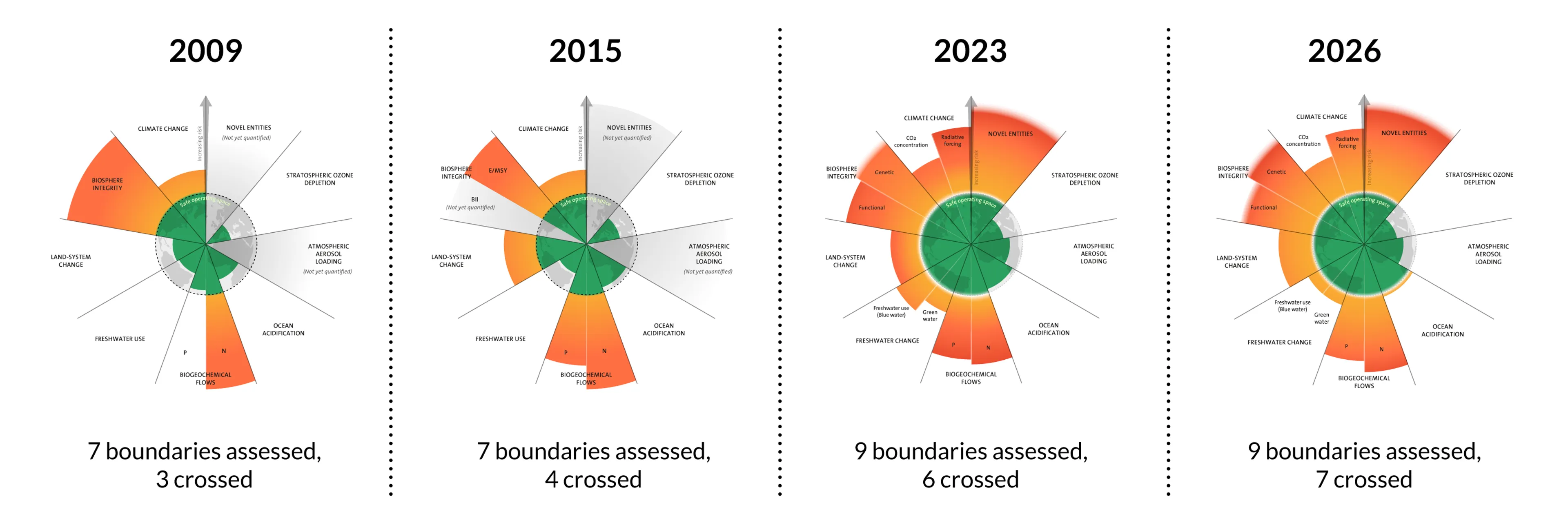
Illustration: The evolution of the planetary boundaries framework. Licenced under CC BY-NC-ND 3.0 (Credit: Azote for Stockholm Resilience Centre, Stockholm University. Based on Sakschewski and Caesar et al. 2026, Richardson et al. 2023, Steffen et al. 2015, and Rockström et al. 2009).
Important steps but more is needed
- 1776The Wealth of Nations. Nature is assumed to be endless.
- 1920sArthur Pigou proposes taxing harmful side effects. Pricing nature is not a new idea.
- 1987The Montreal Protocol. The ozone layer starts to heal.
- 2005EU Emissions Trading System starts pricing emissions from heavy industry.
- 2015The Paris Agreement. Each country sets its own targets.
- 2023CBAM. The EU adds a carbon charge on certain imports.
- NextLaghum Economy. A single country can start, without waiting for a global agreement.
Why change hasn't happened yet
Why today's efforts haven't had the effect we need
Many good environmental policies work in theory but ask too much of the people and companies who have to follow them. It is a bit like a medicine with side effects so hard that patients stop taking it. We see three main reasons.
Taxes at production
When environmental taxes hit producers, people worry about competitiveness and jobs. The taxes are then often dropped or watered down before they work.
Global agreements are hard to reach
Waiting for every country to agree has proven slow. In a more fragmented world, it may get even harder.
The Jevons paradox
When we use resources more efficiently, they often become cheaper, and we end up using more of them. Efficiency alone does not reduce the total use of nature.
Laghum Economy is designed to be easier to stick with. The tax is paid when we buy, not when goods are made. One country can start on its own. And since the price follows how much nature we use in total, efficiency gains do not simply lead to more use.
Researchers have started to examine the idea, including a report from the Stockholm Resilience Centre and a review in Ekonomisk Debatt.
See the research so farThe domino effect
One country can go first, and others are likely to follow
Laghum Economy does not need a global agreement to start. When a country, or a union such as the EU, goes first, whole supply chains are affected and production shifts towards more resource-efficient solutions. Consumers, the true captains of the market, steer that shift through what they choose to buy.
1One country goes first
It starts shifting tax from work to the use of nature, for example with an SCT on a few product groups. The overall tax level stays the same.
2Its producers get a better margin
Lower tax on work means lower labour costs. The SCT is paid where products are sold, and every seller pays the same, wherever the goods were made. So companies that make their products in the country that goes first earn a better margin than their competitors, whether they sell at home or abroad.
Producer in the country that goes first
Competitor elsewhere, with higher tax on work
Other costsLabour, incl. tax on workMargin
3Others follow because it pays
Not because they have signed an agreement, but because they see the advantage. Global change becomes possible without having to start globally.
Simplified illustration
Rich countries are a natural place to start. They use the most resources per person and fund much of their welfare through taxes on work. In Sweden, taxes on work make up just over half of all tax revenue.
We don't have all the answers or a finished plan, but we have a clear direction.
The idea is described in full in the book The Laghum Economy. For the complete picture, we recommend reading it.
Get the bookJoin the movement
Sign up to the newsletter
News, events, new podcasts and articles from Laghum Economy.